
Call+91 73377 76666
NestPack Private Limited
Call+91 73377 76666
NestPack Private Limited
Electronics

Anti-Static Foam Inserts & ESD PCB Tray Foam — India

Anti-static, dissipative and conductive foam fitments engineered in Bengaluru 560066 for PCB and SMT lines, semiconductor sub-assemblies, instrument cases and connector kits. ANSI/ESD S20.20 aligned material selection, RoHS-compliant grades and CNC-cut precision — supplied to EMS, semiconductor and instrument OEMs across India.

+91 96863 88696 +91 73377 76666
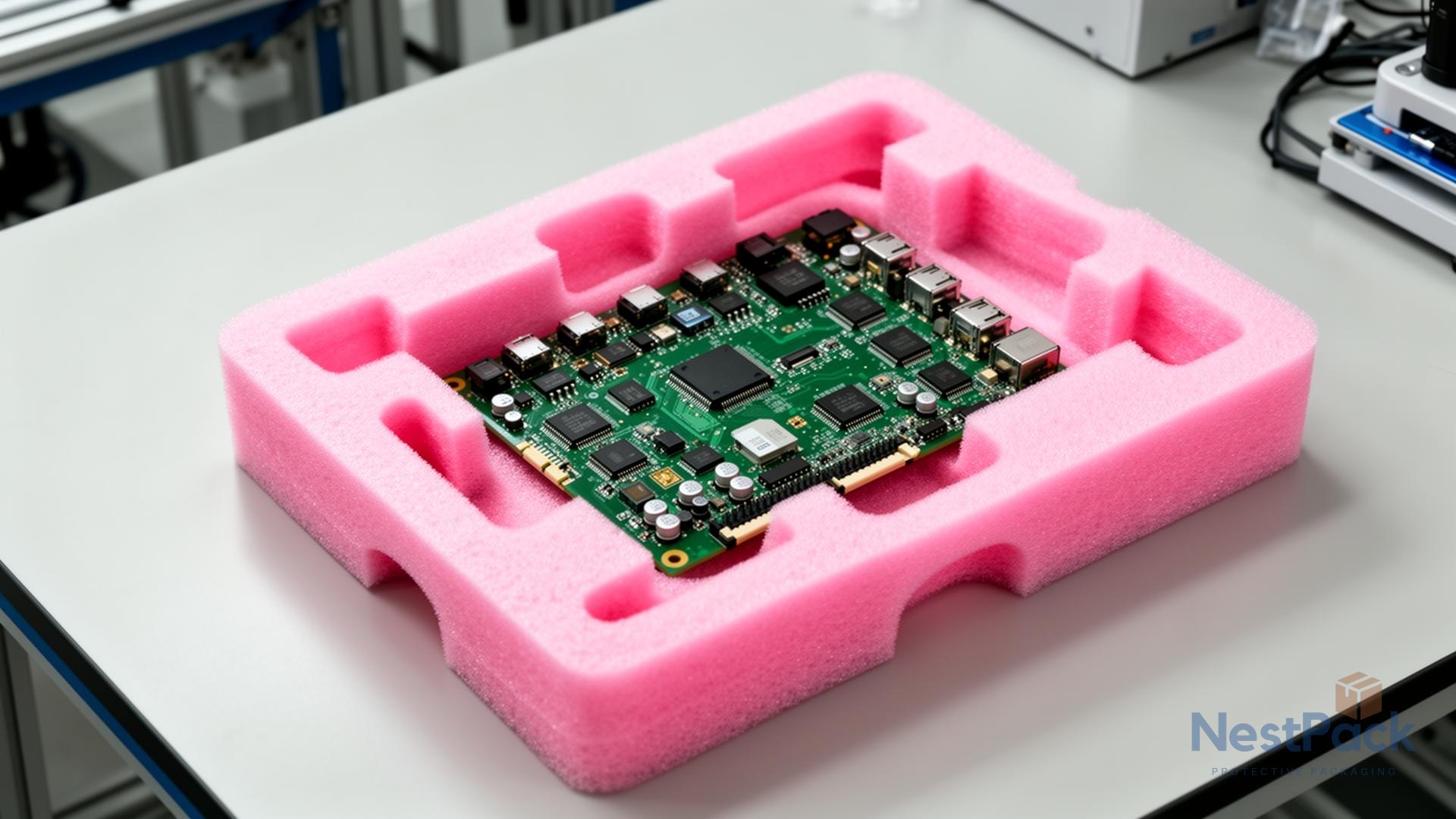
Anti-static ESD foam PCB tray manufactured by NestPack Bengaluru 560066
Design Philosophy

Foam Engineered for ESD Control

An electronics foam insert has two jobs — mechanical cushioning and electrostatic control — and they trade off differently for a bare-die semiconductor than for a fully assembled bench instrument. The wrong ESD grade can either fail to protect a 10 V-sensitive component or, worse, ground a live PCB through its metal chassis.

We design every electronics fitment around six engineering pillars, matched to ANSI/ESD S20.20 and IEC 61340-5-1 references, so the resistivity, density and geometry actually fit your line and your product's ESD class.

ESD-graded materials

Anti-static, dissipative and conductive grades matched to the ESDS component's sensitivity class.

PCB & panel fit

Tool-controlled cavities sized to your PCB panel, SMT carrier or wafer FOUP tote.

Shock & vibration

Cushioning density chosen against the instrument's fragility curve, not a generic thickness.

Stackable trays

Multi-layer trays with rigid separators and lid foam for reflow-oven and inter-plant transit.

Cleanroom friendly

Closed-cell, skin-finished foams that don't shed fibre into connectors or optical ports.

RoHS / REACH docs

Supplier RoHS and REACH declarations passed through for EU-facing electronics OEMs.

Design Process

From ESD Class to Documented Tray

  1. 01
    ESD requirements

    Component class, HBM sensitivity, handling environment and grounding scheme.

  2. 02
    CAD intake

    STEP / IGES / DXF / DWG under NDA — or a physical PCB / instrument sample.

  3. 03
    Material selection

    Anti-static PE, dissipative XLPE, conductive PU or high-density support foam per zone.

  4. 04
    Prototype & fit-check

    CNC-machined sample, in-line trial with your ESD-safe carriers, drop and compression validation.

  5. 05
    Resistivity documentation

    Supplier resistivity range and RoHS / REACH declarations filed with the customer quality record.

  6. 06
    Production

    Batch CNC with colour-coded ESD zones, serialised trays and controlled dispatch from Bengaluru 560066.

Material Selection Matrix

The Right Foam for the Right Electronics Job

Material & densityCompression setTypical electronics use
Anti-static pink PE (30 kg/m³)Low (~12%)General PCB handling, light connector kits
Anti-static pink PE (60 kg/m³)Low (~10%)Stackable SMT carrier trays, sub-assembly transport
Dissipative XLPELow (~8%)Instrument cases, semiconductor sub-assembly cradles
Conductive black PURecovers fullyIC / ESDS component pin-shorting, high-sensitivity carriers
XLPE 90 kg/m³ (support)Low–Medium (~8%)Structural cushioning under ESD contact face
PU ester (skinned)Recovers fullyOptical ports, lens-mounted PCBs, sensor modules

Resistivity ranges are supplier-declared for the grade; final compliance depends on test method (ASTM D257) and the customer's ESD control program.

Standards & References

Aligned to Electronics ESD References

NestPack designs and documents electronics foam fitments aligned to the references below. We do not claim independent ESD certification of finished trays — that sits with the customer's ESD control program audit.

ANSI/ESD S20.20

ESD control program reference — our materials sit in the low-charging and dissipative categories.

IEC 61340-5-1

International ESD control standard — resistivity ranges we design around.

IPC-1601

PCB handling and storage reference — informs closed-cell surface finish choice.

RoHS 2011/65/EU

Material declarations for foams supplied into EU electronics OEMs.

REACH SVHC

Substance-of-very-high-concern declarations from our foam suppliers, passed through on request.

ASTM D257 / D3575

Surface resistivity and foam density / compression-set test references.

Case Studies

Electronics Foam Fitments in the Field

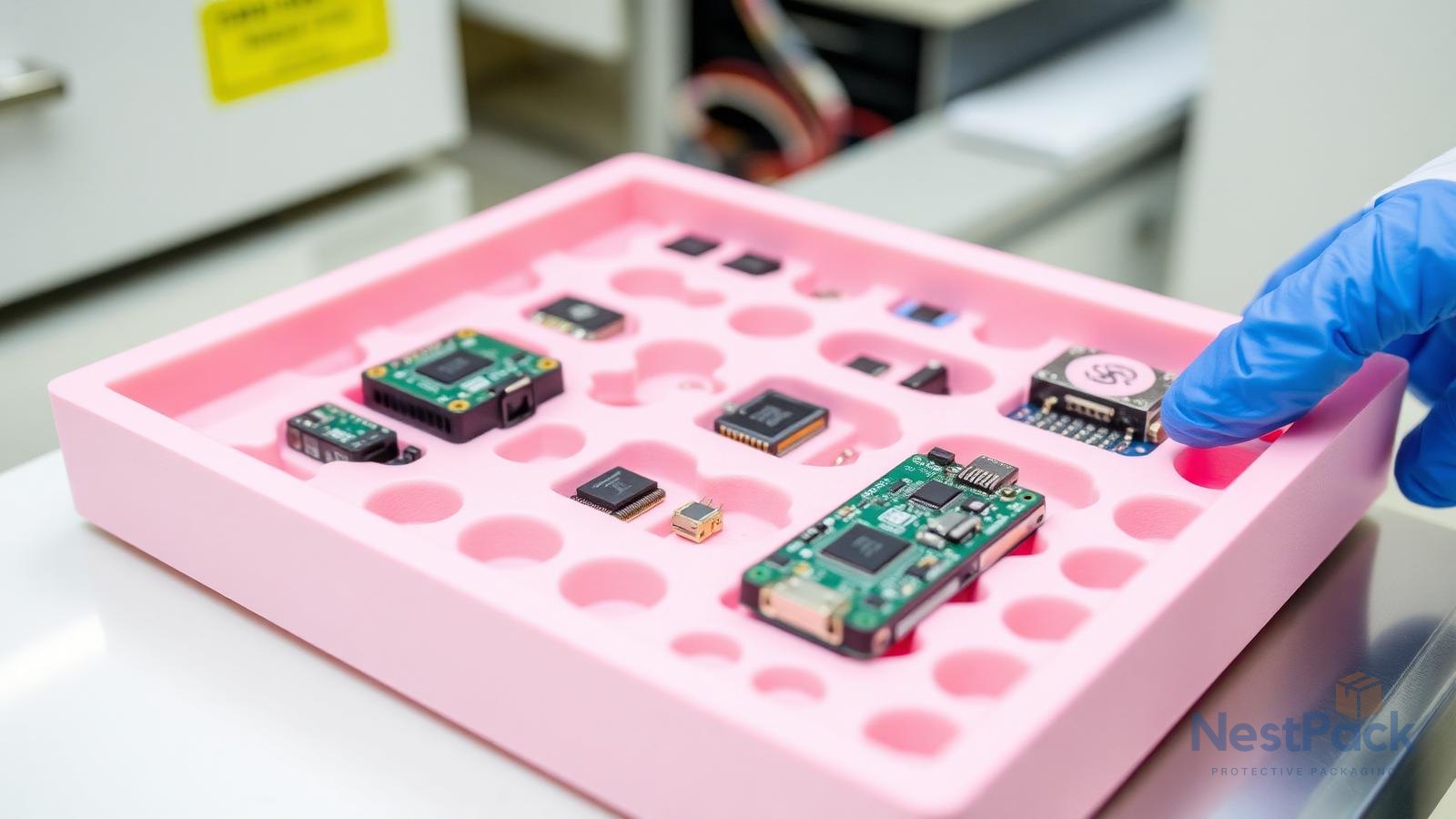
SMT panel carrier tray

Problem

EMS line was seeing solder-joint stress after depanel on multi-layer boards sitting on a rigid tote.

Solution

Anti-static pink PE 60 kg/m³ carrier tray with panel-shaped cavity and matching lid foam for stackable transit.

Outcome

Depanel scrap dropped and inter-plant transit damage eliminated on the pilot line.
Oscilloscope hard case foam

Problem

Bench-top oscilloscope was arriving at field-service sites with knob shafts bent from courier drops.

Solution

XLPE 90 kg/m³ dissipative cradle with capture features on the fascia, inside an IP-rated hard case.

Outcome

Field-service warranty returns for cosmetic and knob damage went to near-zero.

Sensor sub-assembly transporter

Problem

Semiconductor sub-assembly was picking up 200–400 V of triboelectric charge during inter-plant transit.

Solution

Dissipative XLPE tray with a conductive PU pin-shorting layer and grounded tote-level bonding path.

Outcome

Verified charge on receipt stayed below the customer's 100 V handling threshold.

Applications

Where Our Electronics Foam Ships

  • PCB & SMT carrier trays
  • Semiconductor FOUP tote inserts
  • Connector & harness kit foam
  • Instrument case foam (scopes, analysers)
  • IC / ESDS component pin-shorting foam
  • Sensor & optical module cradles
  • Server & rack accessory foam
  • Consumer-electronics retail inserts
Gallery

Electronics ESD Foam — In Production

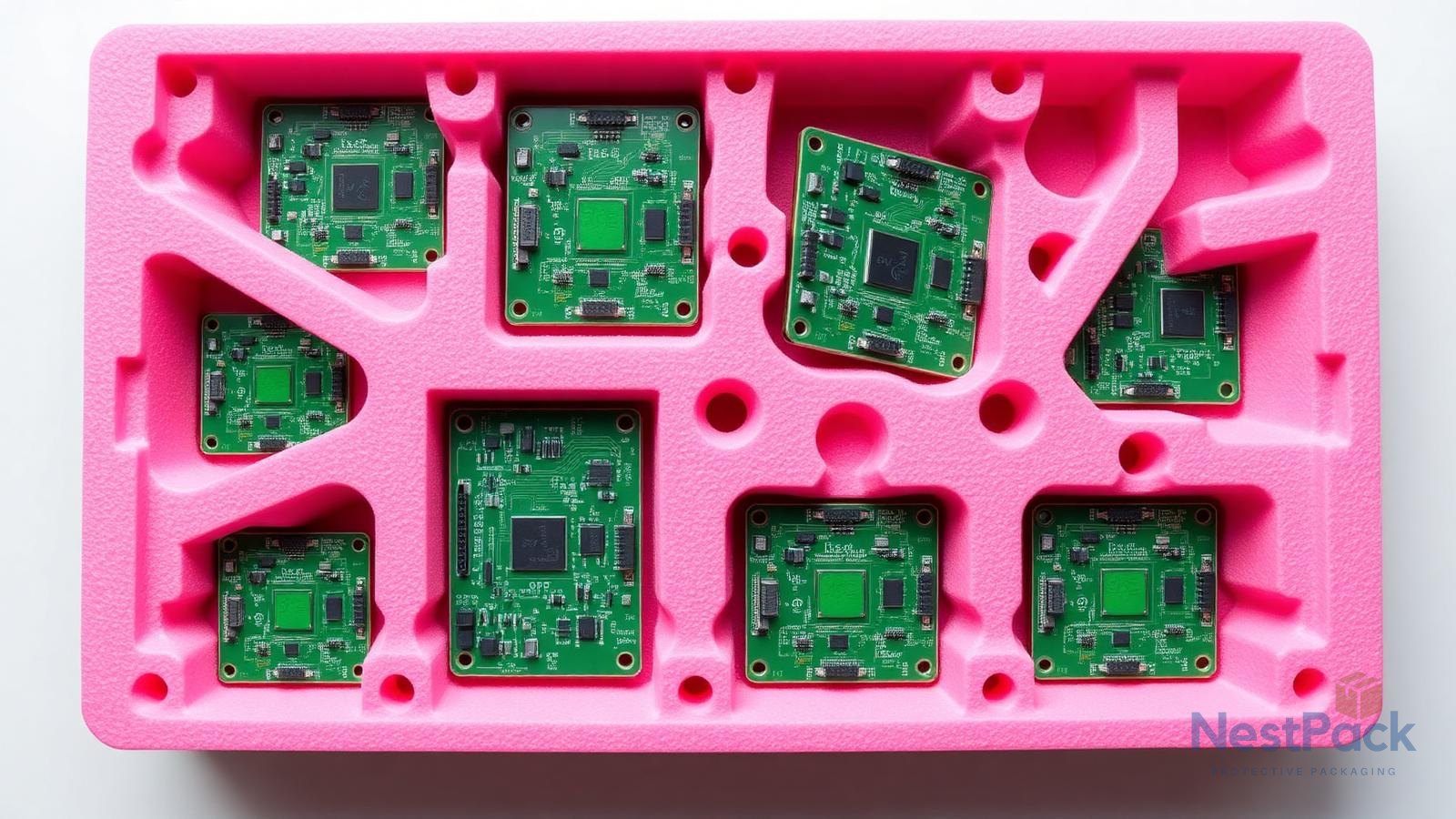
NestPack anti-static ESD foam insert manufactured in Bengaluru — view 1
NestPack anti-static ESD foam insert manufactured in Bengaluru — view 2
NestPack anti-static ESD foam insert manufactured in Bengaluru — view 3
FAQ

Electronics ESD Foam — Common Questions

What is the difference between anti-static, dissipative and conductive foam?

Anti-static foam (surface resistivity 10⁹–10¹¹ Ω/sq) prevents triboelectric charge build-up during handling. Static-dissipative foam (10⁶–10⁹ Ω/sq) drains an existing charge safely to ground. Conductive foam (below 10⁴ Ω/sq) is used for shorting pins on ICs and highly ESD-sensitive components. We supply all three grades — pink anti-static PE, dissipative XLPE and black conductive PU — from our Bengaluru 560066 facility.

Do you supply ESD foam trays for PCB assembly lines?

Yes. We CNC-machine anti-static and dissipative foam trays sized to your PCB panel or SMT carrier. Trays can be stacked, colour-coded per line, and supplied with matching lid foam for reflow-oven and depanel storage in Indian EMS plants.

Are your ESD foams RoHS and REACH compliant?

Yes. Our anti-static PE, dissipative XLPE and conductive PU foams carry supplier RoHS and REACH declarations, which we pass through on request for electronics OEMs shipping into EU markets.

Can you build foam inserts for instrument cases and semiconductor totes?

Yes. We machine XLPE, PU and anti-static foam inserts for oscilloscopes, spectrum analysers, hand-held test gear, wafer FOUP totes and semiconductor sub-assembly transporters. Designs are driven by CAD, a physical sample or 3D scan under NDA.

What is the typical lead time for anti-static foam inserts?

Prototype samples ship in 5–8 working days from our Bengaluru facility once CAD or a physical sample is approved. Production batches run in 2–4 weeks depending on density, ESD grade and quantity.

Need an ESD foam insert designed?

Send PCB or instrument drawings, CAD or a sample — we'll engineer the anti-static foam tray from our Bengaluru 560066 facility.

Related industries:AerospaceDefenceMedical
Email SalesContact Form