
EPE Foam vs XLPE Foam: Complete Comparison Guide
In short: EPE (Expanded Polyethylene) is the lower-density, lowest-cost-per-m³ choice for single-trip cushioning, while XLPE (Cross-Linked Polyethylene) is denser, tougher, waterproof and reusable for 50+ cycles with a far finer CNC finish. Below: density, compression strength, cost and durability side by side — plus a decision matrix — and we turn either into custom foam inserts from your drawings.
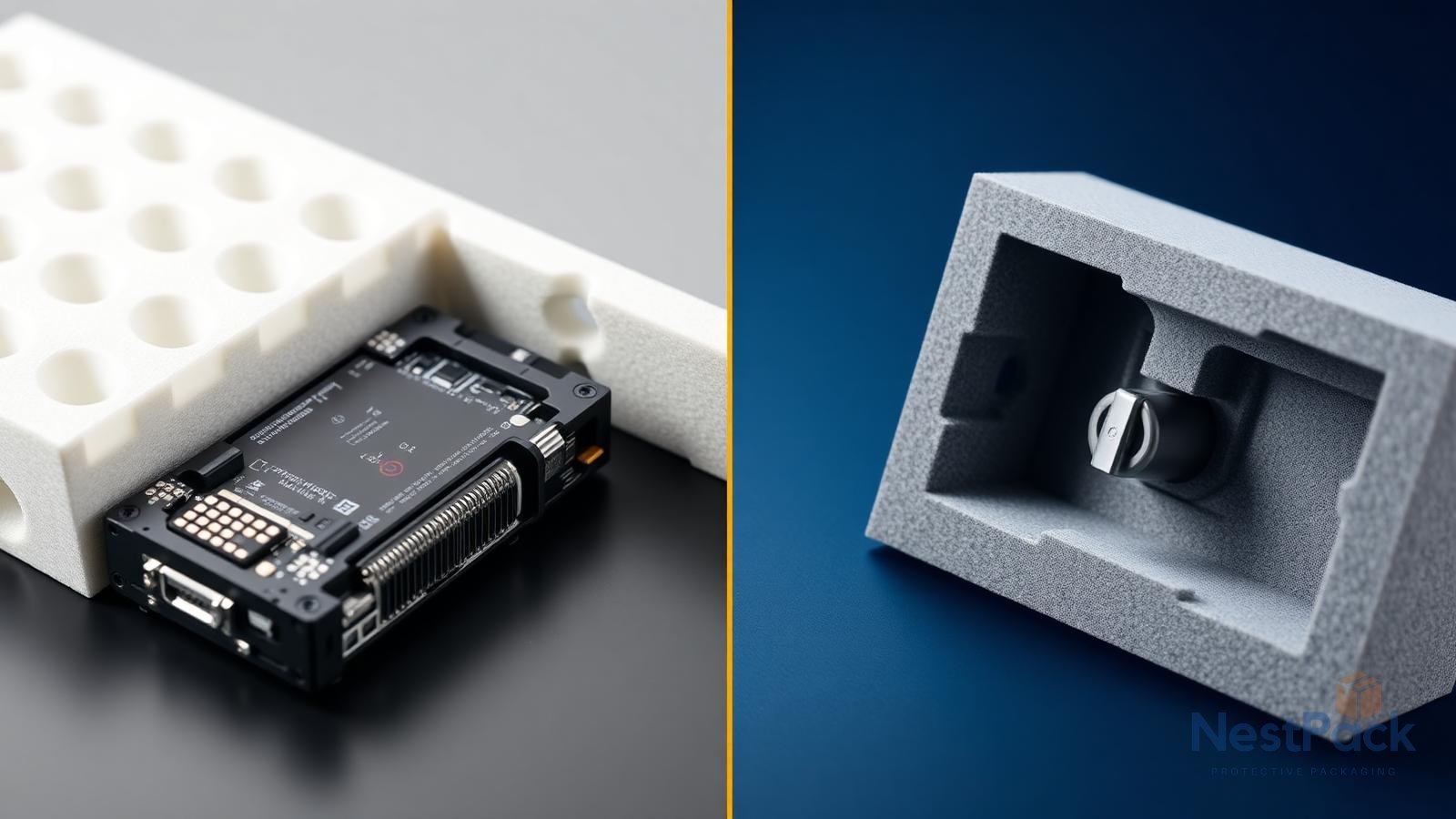
EPE vs XLPE Foam at a Glance
Short on time? This table covers the twelve differences that decide most purchases. The full engineering breakdown follows below.
| Property | EPE Foam | XLPE Foam |
|---|---|---|
| Density range | 18–35 kg/m³ | 25–90 kg/m³ |
| Cell structure | Closed-cell, non-cross-linked | Closed-cell, chemically cross-linked |
| Surface finish | Slightly textured, matte | Fine, smooth, premium |
| Shock absorption | Good — single-trip cushioning | Excellent — repeated impacts, 50+ reuse cycles |
| Water absorption | Low | < 1% by volume (waterproof) |
| Chemical resistance | Moderate | High — oils, fuels, solvents |
| Temperature range | −40 °C to +80 °C | −60 °C to +90 °C |
| CNC / die-cut finish | Clean, ±1 mm tolerance | Razor-sharp edges, ±0.5 mm |
| Anti-static options | Pink ESD grade | Pink ESD + dissipative black |
| Recyclability | 100% recyclable LDPE | Reusable many cycles; not regrind-recyclable |
| Relative cost | Baseline (lowest ₹/m³) | 2–4× EPE per kg |
| Best for | One-way transit, lightweight goods, high-volume packaging | Hard cases, reusable fitments, defence/medical/aerospace export |
Rule of thumb: pick EPE when cost and single-trip protection drive the decision; pick XLPE when the foam lives inside a reusable case or protects high-value equipment for years.
What is EPE Foam?
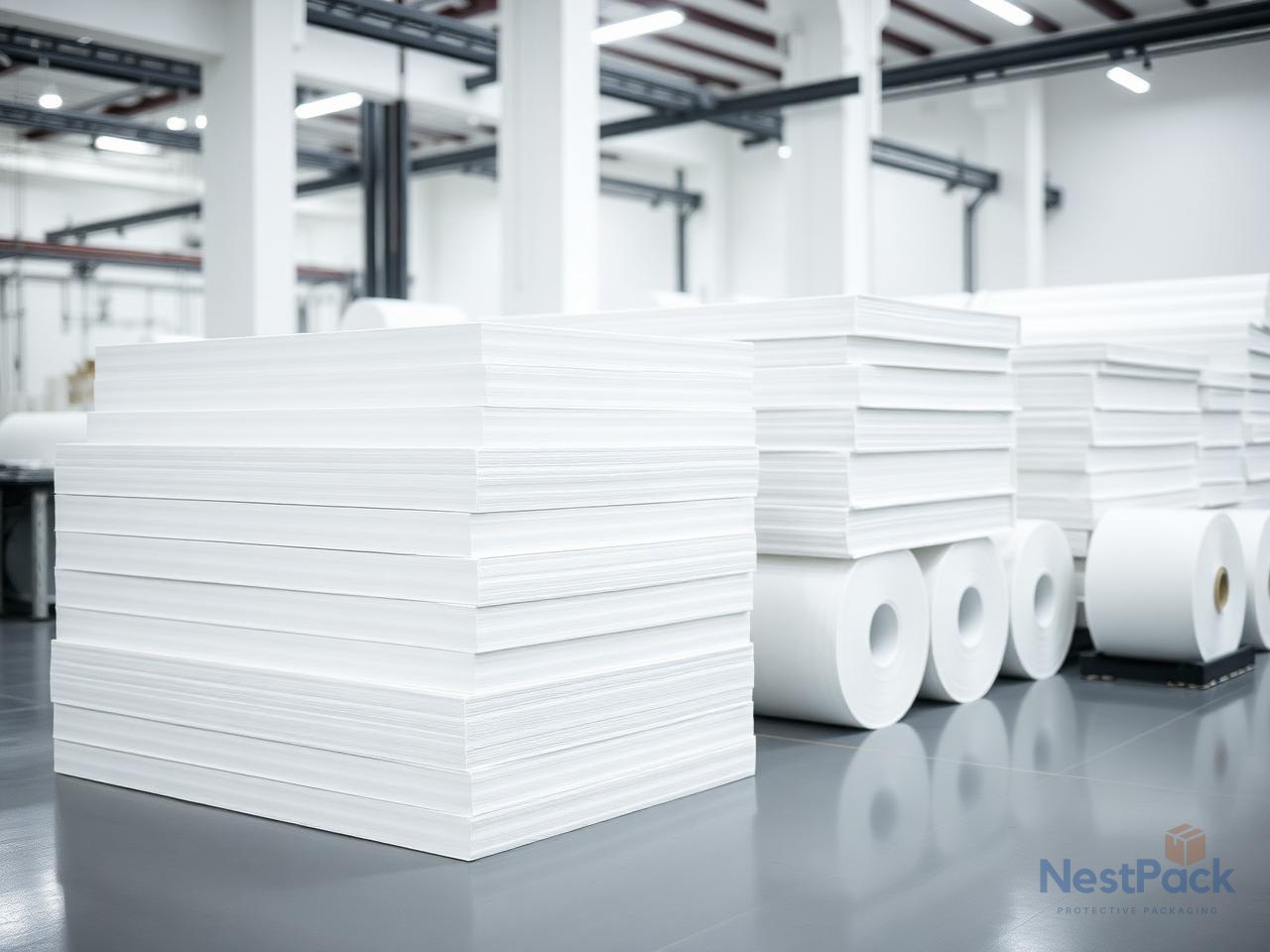
EPE Foam (Expanded Polyethylene) is a lightweight, closed-cell thermoplastic foam produced by expanding low-density polyethylene with a physical blowing agent. It combines flexibility with resilience — recovering its shape after repeated compression — which makes it the workhorse of protective packaging across Indian manufacturing.
Standard EPE ships in densities from 18 to 35 kg/m³ and sheet thicknesses of 5 mm to 100 mm. It is available in white (standard), pink and black (anti-static grades), and can be laminated with PE film, aluminium foil or reflective mylar. For electronics packaging, NestPack manufactures ESD-safe pink and dissipative black EPE with surface resistivity of 10⁹–10¹¹ Ω.
EPE cuts cleanly on CNC routers, hot-wire tables and rotary die presses, producing zero-dust edges and low waste — a key reason it is the default material for pluck-foam layers, corner blocks, edge protectors and large-format shipping inserts.
What is XLPE Foam?
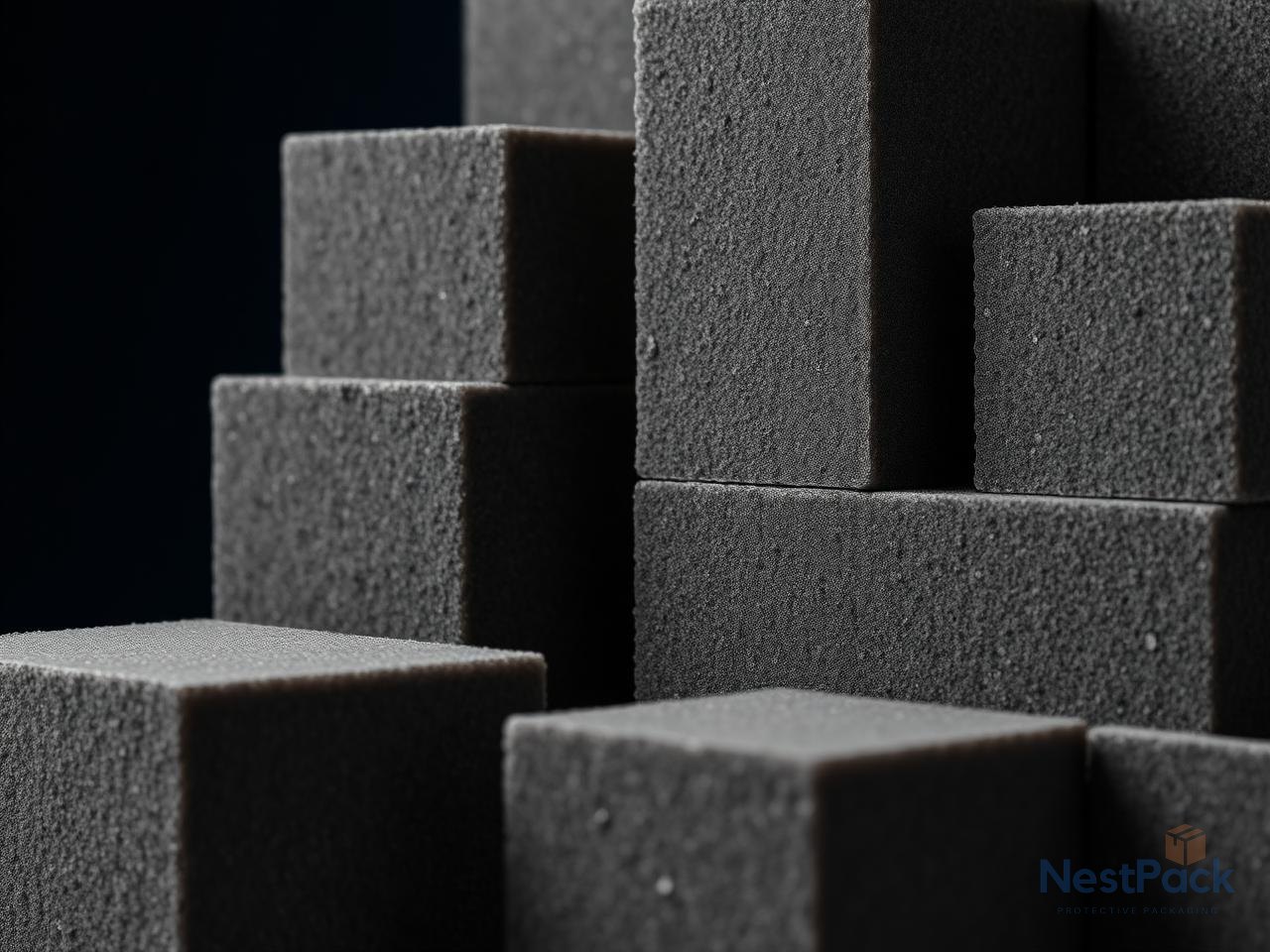
XLPE Foam (Cross-Linked Polyethylene) is manufactured by chemically or electron-beam bonding polyethylene chains before expansion. The cross-linked matrix produces a finer, more uniform closed-cell structure with dramatically higher density, tensile strength and thermal stability than standard EPE.
XLPE is the industry-standard foam for premium hard cases (Pelican-style, Explorer, Nanuk), CNC-cut precision inserts, defence transit kits and medical device presentation trays. Densities range from 25 to 90 kg/m³, with a service temperature window of −60 °C to +90 °C — well beyond the operating envelope for aerospace flight-line and defence field kits.
The fine, smooth XLPE surface accepts water-jet, CNC and skiving cuts with razor-sharp edges — essential for the crisp cavity fits customers expect in high-value equipment cases. Water absorption is below 1 % and resistance to oils, fuels and cleaning solvents is excellent.
EPE vs XLPE Foam: Key Differences at a Glance
| Attribute | EPE Foam | XLPE Foam |
|---|---|---|
| Material | Expanded Polyethylene (non-cross-linked) | Cross-Linked Polyethylene |
| Density (stocked grades) | 18 – 35 kg/m³ | 25 – 90 kg/m³ |
| Surface Finish | Soft, slightly open pore | Fine, smooth, premium |
| Water Resistance | Good (< 3% absorption) | Excellent (< 1% absorption) |
| Compression Strength | Moderate | High, consistent recovery |
| Durability | 3 – 5 reuse cycles | 50+ reuse cycles |
| Appearance | White, pink (ESD), black | Black, grey, charcoal, colours on order |
| Shock Absorption | Great for light-medium loads | Great for heavy, fragile & precision loads |
| Chemical Resistance | Good | Excellent (oils, solvents, fuels) |
| Relative Cost | ₹ Low | ₹₹₹ Premium |
| CNC Machining | Yes — clean cuts, low waste | Yes — best finish, sharp edges |
| Export Packaging | Suitable with outer carton | Preferred for high-value export |
| Reusability | Limited | Excellent — hard-case standard |
Technical Specification Sheet: EPE vs XLPE Foam
Procurement and packaging engineers usually need numbers, not adjectives. The table below lists the mechanical, thermal and electrical properties we quote against for EPE and XLPE foam, with the corresponding test method so the values can be cross-checked against your own drawing or specification. Actual values depend on the density selected — share your target and we will confirm the grade on the datasheet.
| Property | Unit | Test method | EPE foam | XLPE foam |
|---|---|---|---|---|
| Density range | kg/m³ | ASTM D3575 / ISO 845 | 18 – 35 | 25 – 90 |
| Compression strength @ 25% deflection | kPa | ASTM D3575 Suffix D | 25 – 55 | 40 – 150 |
| Compression set (24 h, 50%) | % | ASTM D3575 Suffix B | 12 – 20 | 5 – 10 |
| Tensile strength | kPa | ASTM D3575 Suffix T | 150 – 320 | 300 – 900 |
| Elongation at break | % | ASTM D3575 Suffix T | 90 – 160 | 120 – 250 |
| Water absorption (by volume) | % | ASTM D3575 Suffix L | < 3 | < 1 |
| Thermal conductivity | W/m·K | ASTM C518 | 0.038 – 0.042 | 0.033 – 0.038 |
| Service temperature | °C | Manufacturer data | −40 to +70 | −60 to +90 |
| Surface resistivity (ESD grade) | Ω | ASTM D257 | 10⁹ – 10¹¹ (pink) | 10⁶ – 10⁹ (black) |
| Standard sheet size | m | — | 1 × 2 | 1 × 2 |
| Thickness range | mm | — | 5 – 100 | 5 – 100 |
| CNC / die-cut tolerance | mm | In-house QC | ± 1.0 | ± 0.5 |
| Typical reuse cycles | cycles | Field data | 3 – 5 | 50+ |
Values are typical ranges across the density grades NestPack stocks and are for design guidance; a batch datasheet is issued with production orders.
Advantages of EPE Foam
Cost-Effective
Lowest ₹/m³ among protective foams — perfect for high-volume packaging.
Lightweight
Cuts freight cost on air and sea shipments without sacrificing protection.
Recyclable
100% LDPE — can be regrind-processed at end of life.
Anti-Static Available
Pink and black ESD grades protect PCBs and semiconductor components.
Easy to Fabricate
CNC, hot-wire, die-cut and hand-cut clean and fast.
Vibration Damping
Cushions vibration in road, rail and air freight over long distances.
Advantages of XLPE Foam
Premium Presentation
Fine, uniform surface elevates the unboxing of high-value equipment.
Waterproof
< 1% water absorption — ideal for marine, defence and outdoor kits.
Chemical Resistant
Withstands oils, fuels, solvents and cleaning agents without degradation.
Reusable 50+ Cycles
Retains geometry inside hard cases through years of field use.
Extreme Temperature
Stable from −60 °C to +90 °C for aerospace and defence deployment.
CNC-Perfect Finish
Machines to razor-sharp edges — the standard for pluck-foam and precision inserts.
Industry Applications
Electronics
PCB trays, server components, semiconductor wafers, ESD-safe cases.
Medical
Surgical instrument trays, diagnostic devices, sterilisation-compatible foams.
Automotive
OEM part kits, sensor packaging, dealer service consumables.
Aerospace
Avionics, flight-line tool kits, satellite components, MRO shipping.
Defence
Weapon systems, night-vision optics, communication gear, munitions transit.
Industrial Equipment
Precision gauges, calibration tools, spare-part kits for heavy machinery.
Robotics
End-effectors, LiDAR, actuators — protected in reusable field cases.
Telecom
Base-station modules, RF filters, fibre modules for site deployment.
Industrial Application Examples: How the Choice Plays Out
Six representative builds from NestPack's Bengaluru plant, showing the material, density, construction and the reason the material was selected. Use them as a reference point when specifying foam for a similar component.
Electronics / PCB
Controller boards shipped from a Bengaluru EMS unit to assembly lines in Pune and Chennai, 400 pcs per week.
- Material specified
- Anti-static pink EPE, 30 kg/m³, 25 mm
- Construction
- Die-cut EPE tray with 6 board pockets in a 5-ply corrugated box; ESD surface resistivity 10⁹–10¹¹ Ω.
- Why it works
- Lowest cost per board with ESD compliance; the tray is one-way and recyclable at the receiving plant.
Medical devices
Portable patient monitor with a glass display returned for service in a reusable case.
- Material specified
- XLPE, 45 kg/m³ cavity layer over 33 kg/m³ base
- Construction
- CNC-milled two-layer XLPE insert in a waterproof hard case; ±0.5 mm cavities for the monitor, probe and cables.
- Why it works
- Wipe-clean closed-cell surface, no fibre shedding, and geometry retained over years of service loops.
Defence / optics
Night-vision sights and thermal optics moved between depots in high humidity and desert heat.
- Material specified
- XLPE, 60 – 90 kg/m³
- Construction
- Pluck-and-mill hybrid XLPE inserts, base plus lid pad, in an IP67 case rated −60 °C to +90 °C.
- Why it works
- Under 1% water absorption and stable cavity fit after repeated field handling and pressure changes.
Aerospace MRO
Flight-line tool kit with 42 calibrated tools requiring shadow-board accountability.
- Material specified
- XLPE, 60 kg/m³ top layer, contrast base
- Construction
- CNC-cut shadow-board XLPE with contrasting under-layer so a missing tool is visible at a glance.
- Why it works
- Faster tool audits, no FOD risk from crumbling foam, and durable edges after thousands of removals.
Automotive OEM parts
Painted plastic trim and sensors sent daily from a Tier-1 supplier to an OEM line.
- Material specified
- EPE, 25 kg/m³, 20 mm sheet and profiles
- Construction
- EPE profile sleeves plus die-cut EPE layer pads in returnable plywood boxes.
- Why it works
- Scratch-free class-A surfaces at a fraction of XLPE cost, with pads replaced periodically.
Industrial metrology
Coordinate measuring probes and calibration gauges carried to customer sites.
- Material specified
- XLPE, 90 kg/m³
- Construction
- Milled XLPE nests with finger-relief slots and foam-lined lid pressure pad.
- Why it works
- Repeatable seating for calibrated instruments; foam does not compress out of tolerance.
Need the same worked out for your part? See the custom foam insert design guide or match a case and foam directly in the case & foam finder.
EPE Foam vs XLPE Foam: Which Should You Choose?
Use this decision matrix as a starting point. For borderline cases (mixed weight and export), our engineers spec hybrid inserts — an XLPE structural layer with an EPE cushioning base — to hit the cost and performance target together.
Tight Budget
- EPE: Best value
- XLPE: Premium
Heavy Product (> 15 kg)
- EPE: Compresses over time
- XLPE: Maintains geometry
High Fragility
- EPE: Adequate with thick layers
- XLPE: Best shock control
Export / Long Transit
- EPE: OK with outer carton
- XLPE: Preferred — moisture safe
Luxury Presentation
- EPE: Utilitarian look
- XLPE: Premium finish
Heavy Equipment / Field Kit
- EPE: Single-use
- XLPE: Reusable 50+ cycles
Industries We Serve Across India
From our Whitefield, Bengaluru manufacturing facility we supply custom EPE and XLPE foam packaging pan-India — serving electronics clusters in Chennai, Hyderabad and Coimbatore; automotive hubs in Pune, Ahmedabad, Vadodara, Surat and Nagpur; aerospace & defence programmes in Bengaluru, Mumbai and Visakhapatnam; NCR OEMs in Delhi, Noida and Gurugram; medical device manufacturers in Kochi; and industrial equipment exporters in Kolkata, Jaipur, Lucknow and Indore — with dispatch to every major SEZ, EOU and industrial estate in the country.
Why Choose NestPack
Frequently Asked Questions
Related Guides
Custom Foam Inserts — Design Guide for OEMs
Layer strategy, tolerance and material choice for custom foam inserts.
ReadAnti-Static EPE Foam for Electronics
When to specify pink ESD foam vs conductive black for PCB packaging.
ReadCase & Foam Finder — Match Your Equipment
Interactive tool to match a hard case + custom foam to any component.
ReadRelated Products
EPE Foam
Lightweight closed-cell PE foam for protective packaging.
XLPE Foam
Cross-linked PE foam with premium surface for hard cases.
EVA Foam
Ethylene-vinyl acetate foam for cushioning and inserts.
Anti-Static Foam
ESD-safe pink/black foam for electronics and semiconductors.
Hard Carry Cases
Waterproof polymer cases with custom pluck & CNC foam.
Request a Custom Foam Quote
Send us your product drawing, sample or a photo — you will receive a technical response with material recommendation and pricing within 24 hours.
- Email: sales@nestpack.in
- Phone: +91 96863 88696
- WhatsApp: Chat now